
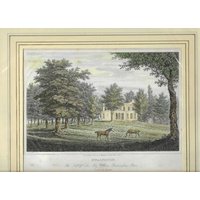
George Brannon was born in Ireland in 1784. . .he was almost entirely self-educated but became one of the most prominent engravers of his time. In his obituary (likely penned by his son Philip), it is mentioned that in his early years as an artist, he displayed great awareness and skill as he progressed through his apprenticeship with the masters. He went on to become an accomplished artist in both water and oil, in addition to possessing a keen eye for architecture. Over the course of the following years, nine new additions were added to the Brannon family of which only six actually survived to maturation, which was in those days fairly common. Their two most well-known offspring were Alfred and Philip, who both followed in their father’s footsteps by becoming renowned artists, engravers, architects, civil engineers, and inventors. . .By 1824, the family business was well-established, and he had developed a style and realistic sharpness that elevated his technique to the level of the masters he had studied. They produced engravings of the Island as well as other nearby cities, including Southampton. . .Both sons Alfred and Philip continued to run the business” (adapted from IslandEye site biography). “During Brannon’s lifetime the handmade prints were sometimes sold individually but most were bound in yearly editions of Brannon’s popular book “Vectis Scenery”, first was published in 1821. This was a hugely popular publication through most of the 19th Century and has been referred to as the Island’s first tourist and souvenir guidebook due to the comprehensive illustrations and maps providing visitors with a unique piece of memorabilia in the age before photography” (Northwood House site). This item is a print of Swainston, Isle of Wight. “Swainston Manor is a Grade II* listed country house located near Calbourne on the Isle of Wight, England, recognized as the oldest standing domestic building on the island, with its core structure dating to the late 12th century and originally constructed as a manor house for the Bishops of Winchester.The manor’s origins trace back to at least 827, as referenced in a charter of King Egbert, and it is recorded in the Domesday Book as held by the Church of Winchester, serving as a key episcopal residence with a chapel and hall complex built between 1174 and 1188. Additions in the 13th century, including a great hall and chapel likely commissioned by Bishop Richard of Ely between 1268 and 1280, enhanced its significance, and King Edward I stayed there in 1285 during his travels. The property remained under the See of Winchester until 1284, when it was seized by the Crown, before passing through various private owners, including the Barrington family in the 18th century, who added a substantial Georgian-style house around 1750 that was later altered circa 1790. In the 19th century, it became associated with literary figure Alfred Lord Tennyson, who visited his friend Sir John Simeon, 3rd Baronet—the then-owner—and is said to have composed parts of his poem Maud there, later penning “In the Garden at Swainston” in tribute after Simeon’s death. The manor suffered severe damage from an incendiary bomb during World War II in 1941, gutting much of the structure except the medieval hall and annex, but it was meticulously restored between 1950 and 1954, preserving its historic fabric including 12th- and 13th-century architectural features like lancet windows, arched doorways, and a C20 reproduction of the original arch-braced roof. Today, Swainston Manor operates as a luxury hotel within its Grade II listed park, offering public access by appointment while maintaining its role as a significant example of medieval and Georgian domestic architecture on the Isle of Wight” (grok site)
Arts & Entertainment > Hobbies & Creative Arts > Arts & Crafts > Art & Crafting Materials
George Brannon Colour Print: Swainston (1822)
£48.00
Visit Retailer to Order


